A modular design system for a regional bank's retail app
At a glance
The challenge
The bank had grown into different teams and different products, and wanted this app's redesign to establish a solid, shared starting point — so the design system was built from scratch, in parallel with the product itself. As design system lead of a dedicated team of 4 designers, I worked on a project team of around 300 people and 25 nationalities — some 20 design profiles alongside PMs, POs, developers, business and analytics — building something that adjusted to business and user needs in a fast, methodical way.
Principles that guided the system
Four principles anchored every decision: design for everyone, make it simple, build trust, and better together. They shaped not just the visual language but how functional and accessible each component needed to be before it shipped — with WCAG AA as the baseline requirement across the system.
A contribution process that scaled
We built the system following atomic design principles, with a governance process that kept quality high without becoming a bottleneck. Anyone could drop a component draft into a shared inbox file — with its requirements, variants and context of use. The central team, split between design and dev and working collaboratively, reviewed and adjusted each component, then shared it with all teams: designed, developed, and fully distributed across 9 different squads. Because the product was being built at the same time as the system, that loop had to run fast — and it did.
The illustration system
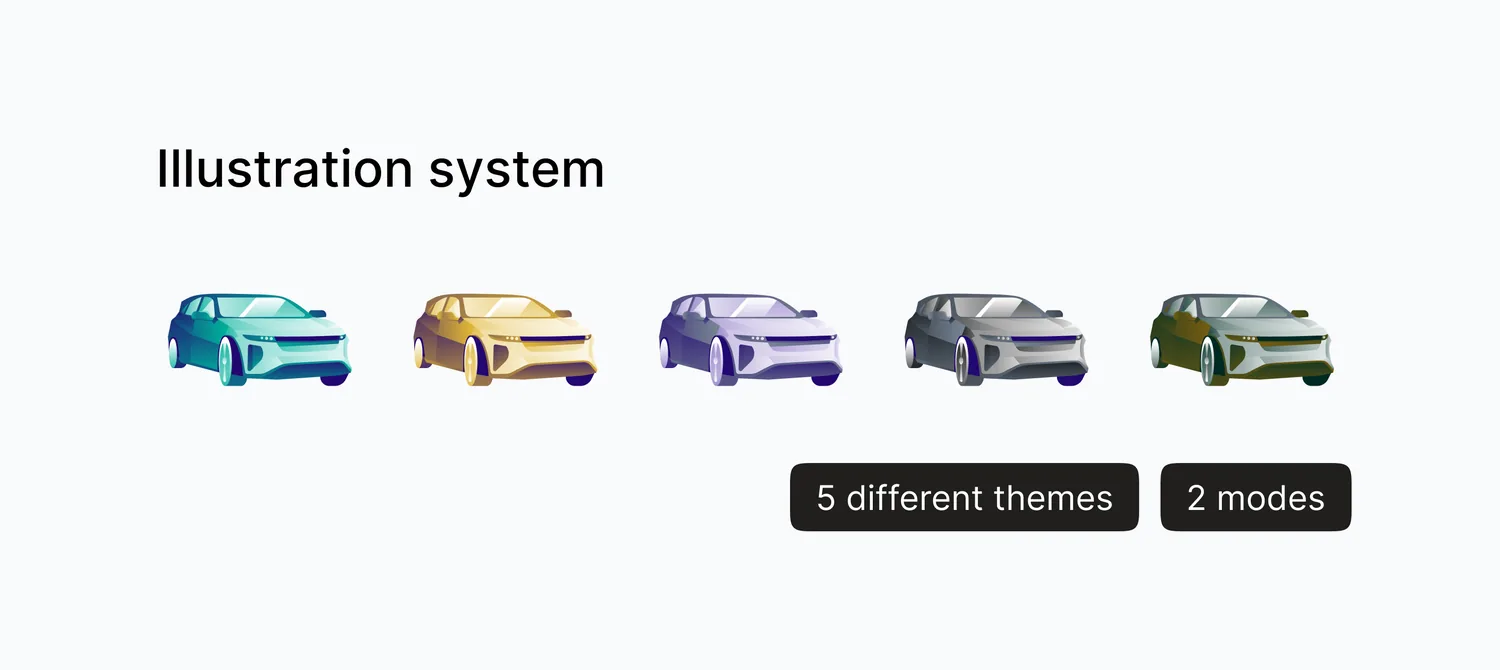
Alongside the component library, we built a full illustration system on the same atomic logic. Each final illustration is composed of objects and shapes that are themselves components, colored using the same color tokens as the rest of the system — with variations by mode and theme. That structure supports 5 themes, 2 modes (light/dark) and 2 sizes (small and large), resulting in more than 67 final illustrations, each composed from a set of different reusable objects.
The outcome
Beyond the numbers, the team documented 12+ guidelines and processes so the system holds up as new features and squads join. Built in parallel with the product, adopted by 9 squads, and aligned across a 300-person, 25-nationality project team — the point was never the component count, it was making the next hundred decisions easier than the last hundred.